Monday, 15 February 2016

Ambidexterity: Cricket's next evolution

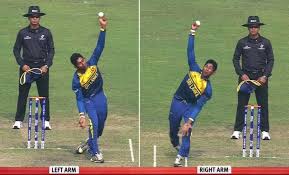
Kamindu Mendis in action(s).


I like the idea of evolution. The Charles Xavier type more than Charles Darwin's. The first X-Men movie starts with a narration by Patrick Stewart that goes something like this: “Mutation: it is the key to our evolution. But every few hundred millennia, evolution leaps forward.”

Cricket finds itself in one such phase, caught in the middle of a jump in evolution. It has changed more in the last 10 years than in the last 100. The tipping point, without a doubt, was the birth of the T20 format. It precipitated bigger bats, longer hits, slower 
bouncers, frequent yorkers, umpires with helmets.

And switch-hits.

Kevin Pietersen’s switch-hit inspired mixed reaction and fierce debate on the legalities, yet everybody agreed on one thing: it was spectacular. Ambidextrous cricketers suddenly became the new buzzword, and ambidexterity is the new cool.

It is no surprise, therefore, that now we have bowlers who can use both arms. Tuesday’s semi-final against India featured Sri Lanka’s batting all-rounder Kamindu Mendis who can bowl both off-spin and left-arm spin.

He prefers to take the ball away from a batter. Mendis bowls right-arm off-spin to left-handers and left-arm tweakers to right-handers, negating the advantage of having a left-right batting combination at the crease. The youngster didn’t get a load of wickets but has certainly cornered a lot of attention. Could he be the product of a generation who grew up watching guys like Pietersen play switch hits? After all, Mendis was only 10 in 2008 when Pietersen first unleashed the shot.

One gentleman who most likely won’t be surprised by Mendis’s ability is John Buchanan, coach of Australia when they were at their most dominant. I remember reading his predictions about ambidextrous cricketers in his aptly named book, ‘If better were possible’. Back in 2003, Buchanan had said: “We’ll have players, hopefully by the next World Cup (2007), who can use both sides of their bodies. I don’t think we will be at the stage when players bowl with both hands in four years’ time — but maybe in eight.”
Buchanan’s timelines may be a bit off but he was certainly on the right track. The number of batters proficient at switch-hitting is on the rise. And ambidextrous bowlers are cropping up too. Take Vidharbha’s Akshay Karnewar, for instance.

With truly ambidextrous players appearing at the U19 and List A level, it is a matter of time before we see these skills on the international stage. While a number of cricketers bat with one hand and bowl with the other, they cannot be called truly ambidextrous.

In one of my earliest blogs, I had argued that it was only common sense for a player who bowls right handed to bat left-handed. This is because a batter’s top hand is his/her dominant hand. Thus it is only natural for people who are naturally right-handed to be taught to bat left-handed, as this ensures that their strong hand becomes their top hand. However, a player can only be called truly ambidextrous if he/she can perform the same skill equally adroitly with both hands.

There can be no doubt that ambidextrous cricketers add variety and excitement to the game. But at what cost? Commentator Harsha Bhogle, back in 2012, labelled switch-hit as ‘unfair’. He said, “(It) strikes at the sanctity of our sport, which must seek to maintain a balance between bat and ball.”

A bowler is required to declare to the umpire (and thus the batter) which side of the wicket he will bowl from, and using which arm. However, when a batter performs a switch, he gives the bowler no such intimation and thus gains an unfair advantage. That the ICC ratified switch-hit despite this anomaly is further proof of the ‘batter’s game mindset’ that dogs cricket.

Baseball, which has encountered both switch-hitters and switch-pitchers, recently introduced the ‘Pat Venditte rule', after an ambidextrous pitcher of the same name came up against a switch-hitting batter. The pitcher must first indicate to the plate umpire with which hand he intends to throw, and then the batter decides from which box he intends to hit. Neither can change their chosen hand during that ball. Safe to say that baseball has more respect for pitchers than cricket has for bowlers?

The trump card of ambidextrous cricketers, batters or bowlers, is the options they create. It is the surprise element. People often speak of a bowler getting inside a batter’s head, and anticipating where he will play. This becomes exponentially more difficult if the batter switches sides and opens up more scoring areas.
Such is the advantage that switch-hitters possess. But the laws give no such advantage to the bowlers. Why not give them the same choice? Imagine if a bowler had the option to bowl over or round the wicket, and with left or right hand, without informing the batter or the umpire? Just as a switch-hitter challenges the bowler to think on his feet, such a situation would keep the better guessing till the last minute. As a bowler, I know I would have loved to have these options while I was playing.

I am glad the switch-hit is legal, make no mistake. Cricket would be poorer without its athleticism and innovation. But just as the game appreciates, authorises and embraces batters who can bath on both sides, so too must it pay attention to the other side of the story. A pugilist who  only strengthens his dominant hand will surely regret it in a fight. 

This article first appeared on Firstpost.com


Mankad? Yes please!


42.15 Law 42.15 – Bowler attempting to run out non-striker before delivery : Law 42.15 shall be replaced by the following: The bowler is permitted, before releasing the ball and provided he has not completed his usual delivery swing, to deliberately attempt to run out the non-striker. Whether the attempt is successful or not, the ball shall not count as one of the over. If the bowler fails in an attempt to run out the non-striker, the umpire shall call and signal Dead ball as soon possible.
- ICC playing conditions 2015

This should be the end of this discussion.

Nevertheless, the furore over Keemo Paul’s alleged chicanery in running out Zimbabwe U19’s Richard Ngarava refuses to die down. A number of players, current and past, called it ‘unsporting behaviour’. Some have said that 'mankad'ing a batter without a warning is not cool. And the spirit of cricket has been invoked as well. Let’s think about all this for a moment.

Firstly, the unsporting behaviour charge. Running between the wickets is fundamentally the skill of covering a fixed distance in the least possible time. Is it sporting for a batter to be allowed to get a head start on a run, thus reducing the distance he or she has to cover, and therefore gaining an unfair advantage, with no fear of losing his or her wicket?

Then there is this business about the warnings. The anachronistic suggestion sounds congruous with the mental image of cricket being “pastoral, staid and moral” as Christian Drury puts it in his excellent blog post. Why would a batter ever leave his crease early? After all, this is the gentleman’s game, and he’s gentleman. And if by chance he did, it is surely an innocent mistake and a gentle reminder shall suffice. And as for today’s well paid professionals? Certainly, let’s give them reminders as well. Would you like some earl grey with that, sir? Milk or cream?

And finally the much bandied about spirit of cricket argument. The 
spirit of cricket, as put down by the MCC, states that:

5. It is against the Spirit of the Game:
To dispute an umpire's decision by word, action or gesture
To direct abusive language towards an opponent or umpire
To indulge in cheating or any sharp practice, for instance:
(a) to appeal knowing that the batsman is not out
(b) to advance towards an umpire in an aggressive manner when appealing
(c) to seek to distract an opponent either verbally or by harassment with persistent clapping or unnecessary noise under the guise of enthusiasm and motivation of one's own side

Since what Paul did was within the laws of the game, it is asinine to call him a cheat. And whatever their actions and the reactions, Keemo Paul and the West Indies U-19 team certainly did not act against the spirit of cricket as described above.

A lot has been said and written about this spirit of cricket over the many years that cricket has existed. The fact is that the ‘spirit of cricket’ was only enshrined in the laws of the game in the year 2000 in the hope that it would “remind players of their responsibility for ensuring that cricket is always played in a truly sportsmanlike manner”.

For me, two words ring out most clearly from that sentence. ‘Truly’ and ‘sportsmanlike’. They tell me that the spirit of cricket is primarily a call for players, umpires, and yes, administrators, to be honest, and fair, above all else. 'Mankad'ing, then does not violate the spirit of cricket. I’ll tell you what I think does:

• That the 2019 cricket World Cup will feature less teams than the 2015 edition, not more.
• That South Africa U19 and New Zealand U19 will qualify directly for the next U19 World Cup by virtue of being full members despite not qualifying for the Super League. Nepal and Namibia though must play a qualifier despite making the Super League, being associate teams.
• That abusive send-offs and verbal volleys are still met with the feeblest of punishments.

These are the issues that threaten the essence of the spirit of cricket, not 'mankad'ing.

The reason Paul’s actions have infuriated a section of the cricketing world are three fold:

Firstly, our default setting while viewing the game tends to find us in what I call the ‘batter’s game mindset’. Suppose Paul had bowled that ball, and the batters ran the three required to win. Suppose there was a run out chance on the third run, and the batter was home by the very margin that Ngarava was dismissed by. Would that be fair to the West Indies?

Secondly, because of the timing, and the context of the match, with a quarterfinal berth at stake and the match poised on a knife’s edge. Paul is being criticised attempting a ‘mankad’ only when the possibility of a loss loomed large, and the odds were against the West Indies. If this is true- and I believe it is- it is only because of the history of shame and stigma we have attached to a perfectly legitimate form of dismissal. Had ‘mankad’ not been demonised as much as it has, fielding sides would use it more often, and batters would be more wary, and there would be fewer outcries.

Thirdly, because it is a ‘man bites dog’ moment. The last instance of a ‘mankad’ in the international game was back in 2014, when Jos Butler was run out by Senanayake. The sheer rarity of its occurrence has also contributed to the controversy that has engulfed it.

The solution to 'mankad'ing is straightforward: To have more of it. Let’s admit that truth that we all know, but few accept: that if cricket ever was the gentleman’s game, now it is the batter’s game. Today’s bowlers have to invent new ways to counter flat tracks, bigger bats, impossible field restrictions, and innovative batters. Let’s give them another weapon in their armoury. Let’s stop frowning on the ‘mankad’, and challenge bowlers to be aware of the non-strikers position as they run in. Let’s put a healthy fear of losing their wicket in the batter’s minds, and keep them honest. Let’s stop looking at this issue from the ‘batter’s game mindset’ and be fair to all involved.

This article first appeared on Firstpost.com

Interview with Anjum Chopra


This season’s edition of the women’s Super League T20 matches (Elite Group) were historic in the Indian context. There had been a buzz around the ground over the couple of days preceding the tournament, as for the first time, four of the six matches were being televised live on Star Sports. After the fourth game, veteran commentator and former India captain Anjum Chopra, who has played in four World Cups, sat down for an exclusive interview with Firstpost.

With the lush outfield of Indore’s Holkar stadium in the backdrop, she shared her insights into both the commentary box and the dressing room in her forthright chat.


Snehal Pradhan:  This is the first time a women’s cricket domestic match is telecast on TV. What are the likely effects for the women’s cricket scene in India?

Anjum Chopra: Look I think it’s a brilliant opportunity for women’s cricket in India to take a leap forward and make rapid strides in improvement. With the televised games, I think obviously a lot of people get to see the women play. Obviously a lot of interest is from the immediate family and friends but people who’ve not seen a lot of girls play cricket, for them it’s a great opportunity.
On the professional front I think as I said earlier, it’s great if the girls can really take up this opportunity and really showcase the high standards of the game that can be displayed or should be displayed. It’s a positive move forward for the women's team.


Star Sports and BCCI have taken up a little bit more interest in broadcasting women's cricket matches over the last few months. First the India-New Zealand series and now these domestic matches. We were also lucky enough to win that ODI series and in these matches too we have seen some really good batting displays by the likes of Mithali Raj and Smriti Mandhana. Do you think Indian women cricket the standard is improving overall? Can you judge by the few games that we have seen?

 The initiative taken by the BCCI to showcase matches with the host broadcaster Star Sports, I think that a brilliant initiative and credit must go to the people who are making decisions in favour of the women’s sport, so that I think is a great opportunity. In terms of the talent being displayed, undoubtedly, Mithali Raj, we all know is a world-class player. She has got phenomenal talent, she doesn't need to prove all this to anybody because she's already a world acclaimed player worldwide. But, as I said it's a great opportunity for youngsters to showcase their talent.

But when I say that, I also say in the same breath that the players need to work extremely hard. A game being televised shows more than it hides. When the game is not being televised you can hide a lot of things but when it is being televised it showcases more and exposes more as well. So when you do that, I do feel that the players have a brilliant opportunity of gaining a lot from this but it’s up to them as well how they ‘Make It or Break It’ because at the end of the day the hard work has to be done by the players to improve in all departments and showcase their talent to the world.


So what you are saying is this (more televised games) will basically increase the accountability for players, coaches and selectors?

No, see when game is televised and a player is batting or bowling, it is the player batting or bowling. If they do well a lot of people get counted for. If they don't do well lot of flak comes to the player’s perspective, so that cannot be hidden. I think a televised game is the best opportunity a player can ever ask for in their playing days. Televised games will always be showcasing what is happening on the ground not the people who are behind the scenes. So it works both ways good/bad. I'm not saying ,I am not even talking about the selectors. I'm talking about the standard and improvements that a player can do in taking an opportunity- that ok, you’re being shown to the world. When you dress up- you’re going to a party- you don't dress shabbily, you always dress up well to showcase yourself when you’re going to a gathering.  Similarly when you come and play a tournament it's not about how you dress up but it's about how you play, how you present yourself, physically, skill wise in every manner, that’s also an opportunity. You can't take the stage lightly. I think it’s for the players to take it up more and for the authorities to handle it better and probably take it to the next level.


Talking about your own experience as a commentator you have been a familiar face on Doordarshan for a while but is it accurate to say that a lot more people know about you after your IPL stint,  and what your experiences have been there?

As long as people know me for good reasons I'm happy with it whether through Doordarshan or IPL. I am very happy to be given an opportunity but as I said at the end of the day (in) any work for me I think sky's the limit for improvement. It’s a job that has to be done well, there is no second opinion to it. You can't have half measures. It’s up to me how much I can improve as a broadcaster and that's my job so that's how I look at it.


You have become a role model and provided a clear pathway for a lot of young girls who might never have thought that women can also be commentators, presenters, broadcasters. When you were growing up did you ever have any role models in the commentary box?

Well, I've always heard a lot of commentators, because I watched a lot of cricket as well. My growing up years have been around cricket and other sports as well.  I wouldn’t say I’ve had any ‘idols’ but I've always enjoyed a lot of commentary coming in from Australia. Bill Lawry has been my all time favourite. But as I said in commentary you can't follow a pattern, you can't be another copy cat or a prototype of something else. Everybody has to find their own individual approach. But yes I've always enjoyed the commentary that comes in during the Ashes. It’s just so interesting; it just makes the match even better with the commentary.  The standard of play is good, the commentary makes it even better, it’s just a completely different package.


For young girls now, who want to get into commentary, what would you say is the pathway?

(Laughs) I don’t know what the pathway is, I’m really not the best person to design a pathway, I’ve just taken the next level or the next step forward, whatever opportunity comes my way. I tried to do the best and become better each day. So if the opportunity comes, only thing I can do is better than my best.  I really don't know what the pathway is.


Besides cricket you also been involved with broadcasting and presenting kabaddi. Do you think the trend is shifting now towards presenters and broadcasters who can present over various sports not just their core competency?

There is no harm being multidimensional. I played kabaddi as well. I’ve played a lot of sports in school, so that helps me. I’ve played sports at national level apart from cricket, so that helps me. So as I said, if you are a multidimensional person and (an) opportunity is presented to you and you can deliver in the manner in which is supposed to be delivered then that is the job at hand. That is what you are there for. I enjoyed my stint with kabaddi. I think it gave me a lot of exposure and experience. Covering cricket is one thing. It is as when you play a sport, everyday you get to the ground and you’re learning something new; even in broadcasting and presenting, everyday you come to the studio or the ground, everyday I learn something new. That's the beauty of it and I love my job.


Favourite co-commentator?

Everybody I worked with especially doing commentary for the women’s matches - I’ve worked with everybody for the first time. Covering the IPL, everybody was a first so I don't have an example to say that I worked with the same person twice or thrice, covering events.
For me it's obviously doing the same and learning to become better at it.


Talking about cricket how much has changed at the International and Domestic level from your playing days?

Well, the standard has gone down from my playing days-which were not so far in the past–well- that's my personal view. I said- the standard has gone down, I don't mean the talent has gone down - the talent is there but the standard has gone down and the results show it as well. It's not a very healthy sign and it’s not good news because you are supposed to be progressing but you can't be taking steps back. But unfortunately we have been taking steps back or we have been saturated as Indian women's cricket so that is what is changed.


Your best and worst memories from your playing days?

If it has to be one then it has to be the (2005) World Cup final. The best memory is playing the World Cup final and the worst memory is losing the World Cup final. In the final we were chasing 215 runs which is not even a par score in today's time, probably it wasn't even that difficult. But I guess as a team at that point of time if we just think back and if you talk to other players also they will all say that we prepared play the World Cup finals. We never prepared to win the World Cup finals. We achieved what we went out for so we can't have a hard time saying that we didn't achieve the target.
But yes winning a world cup is completely different and I'm so sure we missed an opportunity to raise the level of the sport for people in India by a great extent. Because if we had won in 2005 maybe women’s cricket would have been on a different pedestal 10 years down the line, and maybe the situation would have been a lot healthier than what it is today.
So I do feel it was an opportunity let go from all of us who were a part of that team; that we had an opportunity to change careers and futures of many youngsters who were just coming in and wanting to play the sport but, as I said learn from the mistakes and move forward. That’s what I'm hoping for Indian cricket in the future.


Tips for the girls going to Australia? You have a lot of experience there.

(Laughs) They don't need my tips they only need their own performances to help them in Australia.  But yes I do wish them all the best because they will be faced with stiff opposition. They will (need to ) be able to practice or rather implement whatever they have been learning  individually - because few of them have travelled to Australia very many number of times now, they’ve played the  opposition a few times. Results, well, we all know Australia is a much stronger opposition than what India will be but how the results come out will show the development of Indian cricket from the last time they played Australia. Everything is not about the result is also about the process so I'll be eagerly looking at what the processes are and that's going to be the big positive coming out.


This interview first appeared on Firstpost.com

Use your head. Wear a helmet. Always.

It’s been a little over a year since the cricket world was shaken by the death of Phil Hughes. At the time, his death seemed like an anomaly. The binary system of cricket, which so far only dealt in the results ‘win’ or ‘lose’, threw up a chilling third one: ‘death’. Hughes’ passing threw into focus something that most within the game already knew. That cricket, and in fact all sport, has underlying dangers. His death was like the one solar flare that caused us to take a closer look at the sun, only to realise it wasn’t the first, and hasn’t been the last.


Since November 2014, at least four more cricketers have died on the field. Two of these deaths (the Israeli umpire Hilel Awasker and English club cricketer Bavalan Pathmanathan) were triggered by the impact of a cricket ball.


Cricket, stripped down to its most visceral, is an activity in which a projectile is hurled in the direction of the batter for him/her to manipulate. The necessity of taking the very basic precautions while attempting something like that cannot be overstated. Saba Karim and Mark Boucher’s careers could have been much longer had they been wearing a helmet. But even with a helmet, the cricket ball can do serious damage. Stuart Broad had his nose broken by a Varun Aaron bouncer, which sneaked through his helmet grille. And Craig Keiswetter suffered an even more unfortunate fate, when a similar injury permanently hampered his vision, and forced him into early retirement, despite having his helmet on.


Cricket can hurt, make no mistake. Ask Richard Kettleborough’s shins. Ask Ajinkya Rahane’s fingers. Ask anyone standing south of David Warner. But the reason I write this piece, is an incident involving a young cricketer who I have shared a dressing room with. Last month, Humaira Kazi was hit on her head while batting by a misdirected throw that left her unconscious for a few minutes, and with a hairline fracture of the skull. She was lucky that that was all. She would have been safer had she been wearing a helmet, but she considered it unnecessary since she was batting against spin.

Humaira Kazi, who escaped with a fractured skull after beinghit in the head. 


Unfortunately, unless facing a threatening fast bowler, many players prefer not to wear a lid while batting. Is it hubris? Or just poor role models? After all, MS Dhoni does it. But this leaves players like Kazi susceptible to injuries through freak accidents. But a closer look shows us that there is nothing ‘freak’ about them.


The internet tells us that a freak accident is, “an incident, especially one that is harmful, occurring under highly unusual and unlikely circumstances.” It is the type of thing that is seen to be so improbable, it’s not worth the effort of taking protection against. “No need to wear armour on my heel, I’ll never get hurt there”, Achilles probably though. But this excellent story by Andy Bull in the Guardian points out to the public something that my own experience in cricket has already taught me. These freak accidents aren’t as uncommon as you would think.


In my own fifteen years as a cricketer, I have been struck on the head twice. The first time, while batting, a full toss slid off the back of my bat and onto my helmet. The second, a stray ball from the opposition nets hit me on the back of my head. Luckily, I walked away with just a headache. I myself have hit quite a few players on the head with my bowling. In the first of these, the batter wasn’t wearing a helmet. It is a memory that I would rather forget.
My Western Railway teammate and Delhi cricketer Lalita Sharma recalled a rather more painful incident. The full toss she missed nicked the back of her bat and shattered her unprotected nose. She had to be airlifted from Surat to Delhi for reconstructive surgery. Although she was almost miraculously back in action in a week, the doctor said a few centimetres here and there and she could have lost her eyesight.


Considering that women’s cricket is only a small piece in the big Indian cricket pie, even the most conservative extrapolation of my experience with head injuries gives us an idea of the number of these ‘freak accidents’ that must be occurring in India alone. Sceptical? Visit Azad maidan or Oval maidan in Mumbai. At first, the wonder of seeing so many matches being played simultaneously in such a small area will hit you. Once it wears off, it is likely that a cricket ball will. Mumbai’s maidans are a melting pot with all the ingredients to concoct a ‘freak accident’.


The cricket world is not totally unaware of the existing dangers. All test playing nations have agreed to adopt the 2013 British safety standards as stipulated by the ICC, but implementation of these guidelines is the prerogative of each individual board. Some have been more diligent about this than others. Noticed the colourful honeycomb patterned neck protection that all players in the BBL now sport on their helmets? They are a result of a Cricket Australia policy change requiring all national and state contracted players to adhere to updated safety standards. The ECB have already made helmets mandatory for all batters -irrespective of the speed of the bowler- as well as close in fielders and wicketkeepers standing up to the stumps. They are also exploring protective equipment for umpires.


Which raises the question of why the BCCI haven’t yet adopted safer practices. When asked about the ICC directive, a senior BCCI official told Firstpost, “We have issued advisories to all state associations, regarding the new safety standards that have been decided upon with regards to helmets.” However, unlike the ECB and CA, the BCCI have not yet made helmets mandatory. “It is a positive step that they (the other boards) have taken. However, enforcing something like across the country length and breadth of our country is not that straightforward. We have provided clear guidelines about safety precautions that should be taken.”


“Just as we want better phones which have latest technology, players should also keep upgrading their safety equipment. The extra protection post Phil Hughes incident for back side of the skull is the reference point.” Sanjay Bangar, the Indian team batting coach, told Firstpost. But in India, the cricketing fraternity has had to take individual decisions with regards to safety. While whether to wear a helmet or not is a choice left to the player, most coaches agreed that it’s just common sense. Niranjan Godbole, former Maharashtra Ranji trophy cricketer who still plays club cricket in England said, “I always instruct my wards to wear a helmet, even if they are facing a spinner. The risk of a ball hitting the face is always around, especially while playing horizontal bat shots like the sweep and pull.”

Umpire John Ward couldbe the first of many to wear a helmet. He certainly should.


In a Vijay Hazare trophy match last month, umpire Paschim Pathak officiated wearing a helmet. He had watched Aussie umpire John Ward get hit in a Ranji game, and rightly decided to take no chances. And John Ward should be saluted for calling for a helmet in Canberra on Wednesday during the fourth ODI between India and Australia. Once hit, always shy - and right so. Umpire Ward might just set the trend in international cricket.


While the boards of other countries are engaged in collaborative research into the hunt for the perfect helmet, in India a helmet is still an option. This article is an appeal from a former player to the BCCI : make helmets mandatory for all batters at all times. At least for minors under -18, who aren’t considered old enough to make important decisions themselves, there should be no two ways about it. 

That being said, former India cricketer Amey Khurasia, now chief coach with the MPCA added this, “If it should be mandatory for juniors, it should apply to the seniors as well. This isn’t a question of maturity, it’s a question of protecting a player’s life. In such cases, the rules should be same for all age groups.”


Should the BCCI go ahead and make the use of helmets mandatory, many are likely to find such a move a nuisance, just like so many in our country oppose helmets on motorcycles. But in this case, as the caretaker of cricket in this country, the BCCI must make decisions that might upset some, for the good of the many.
It might save the next Humaira Kazi from a fractured skull. It might even save the life of the next Raman Lamba. Surely, that is reason enough.

This article first appeared on Firstpost.com

If you want to contribute to making cricket safer, sign my Change.org petition to make helmets mandatory. 

Sunday, 10 January 2016

King Kane: From Middle Earth to the top of the world


If you enter ‘Lord Of The Rings’ in the Google search bar, it will soon suggest the words ‘New Zealand’, where the movies were shot. If New Zealand is our world’s Middle Earth, then Kane Stuart Williamson is currently King there. No wonder then that he is referred to as ‘The King’ by his charismatic captain Brendon McCullum.


'King Kane' was finally enthroned and anointed by the rest of the world as well as the No. 1 ranked test batsman in the world - the first Kiwi to reach the top spot since the rankings were established.
On his Test debut in India back in 2010 though, things were very different. Facing a mammoth score of 487, he walked in with the score at a tricky 137 for four, against the No 1 ranked Test team in the world then, in their backyard. It was a situation that could have unnerved many-a-debutante, especially one who had made a duck on his ODI debut against the same opponent.


But he responded by becoming the youngest New Zealander to begin his Test career with a century. It was an innings that highlighted two qualities that would be written about for many years to come: his footwork, and his composure.


But for those who knew him closely, his century on debut would have come as no surprise. A natural athlete, the ambidextrous Williamson played a number of sports as a child, but cricket was always his first choice. Initially coached by his father, who played cricket for Northern Districts U-17s, the precocious Williamson stood out since childhood. He routinely played against boys three or four years his senior, as his talent demanded. At 15, he was picked for New Zealand U19, and at 19, after two standout seasons for Northern Districts, he was contracted by New Zealand Cricket (NZC), despite not having played an international game yet.
But having talent is one thing, translating it into performance is quite another. Often the difference between the two is a cool head. That is a quality Williamson has never been short of.


Cast your mind back to the ODI World Cup 2015 league game where Williamson led the Black Caps to victory in a nail biting finish that sent Eden Park into sonic boom. With only Trent Boult at the other end and six runs to get with over 150 balls remaining, Williamson quickly calculated his best option, and serenely smoked a straight drive off Pat Cummins into the stands. The celebration was equally cool, with a smile and fist pump, as if he was saving it for another victory, a bigger dream, one that was not to be.


But despite the disappointment of losing the World Cup final, Williamson has had a stellar 2015. His hundred in the last innings of the second Test vs Sri Lanka was his fifth in 2015, and took him past the record for the most Test runs in a calendar year by a Black Caps player (he now has 1172 runs at an average of 90.15). It also put him level with Ross Taylor in the list of the most Test centuries scored by a Kiwi batter (13). Both are now behind only Martin Crowe, who has 17.


He has played a huge role in the resurgence of New Zealand, along with the likes of Boult, Tim Southee and McCullum. New Zealand has not lost a Test series at home since March 2012. And given that he is only 25, he is touted to end up as their best ever batter.
It’s not just the runs he scores though - it's also the way he scores them. Irrespective of the format, Williamson’s more traditional shot selection has always worked for him. His backfoot play - naturally strong considering his hobbit-esque stature - reminds one of the clean lines made by a sabre rather that the hacking-broadsword motion so many modern batters employ. His saint-like composure at the crease has compelled the word ‘Zen’ to be associated with his batting on numerous occasions.


It is almost as if he doesn’t feel pressure at all. Indeed, in an interview given shortly before his Test debut, he said, “When the pressure is on, rather than ‘handling’ the pressure, you almost ‘don’t register’ the pressure, and then you’re in the place to score runs.” These are life lessons seasoned pros often hand out at the end of their careers. Williamson has wasted no time in wising up.
And if his foot work and composure are always apparent on the field, off the field his modesty shines through. Soft spoken and polite, he has often displayed a sensitivity rarely seen in sportsmen of this era. During the New Zealand vs Pakistan 2014 ODI series he donated his entire match fee for all five ODIs to the victims of the 2014 Peshawar school massacre. In press conferences, he rarely seems to show emotion, yet does not seem to be hiding any either. As part of the team which was sledged for being ‘too nice’ by the Australians, he is the nice guy who is finishing first.
For the man who is the captain-elect of the Black Caps, and will lead the team in the absence of Brendon McCullum at the World T20 in India, captaincy is his next Everest.


McCullum has left him a rich inheritance, one which he could nurture into something legendary. Much like the hobbits made the obscure Shire famous in J.R.R. Tolkien’s magnum opus, this middle order batter from Middle Earth has all the ingredients to make rugby-mad New Zealand famous for cricket as well.

This article first appeared in my column on Firstpost.com 

The IPTL: Tennis is more fun as a team sport

The second edition of the IPTL packed its bags on Sunday, with the Singapore Slammers emerging eventual champions. The tournament proved that the success of the first edition wasn’t beginners luck, and that given the participation of a few big names, the format is here to stay.


While I watch tennis only on and off, mostly only at Grand Slams, I found myself unable to switch the channels whenever the IPTL was on TV. I don’t know if it was the innovative rules — with power points and shorter turnaround times — or the star power (personally Sania Mirza was the showstopper for me). Or maybe it was because the format had both a patriotic flavour, as well as a team structure infringing on what is essentially an individual sport. It made me feel like I was watching Davis Cup on steroids, and reminded me of some life decisions I made early in my sporting career.


When I was around 17, and had established myself in the Maharashtra senior cricket team and been touted a future India prospect, my cousin suggested something radical. He advised me to give up cricket. He said I was clearly a good athlete, and I should try an individual sport like tennis.


Around the same time, a Major in the Army Sports Institute in my home town of Pune invited me for some tests. He thought I had the makings of a successful middle distance runner, and he, too, exhorted me to take up the individual game over a team sport.


Their reasons were largely the same: “In team sports, one must rely on others to a great extent in the pursuit of success. You might be good but unless your team is good enough, you will never win. Whereas in an individual sport, your success lies entirely in your hands.”


My reasons for not taking their advice were simple: I loved cricket. Not tennis. Certainly not athletics. Cricket.


Thinking back now, one of the reasons I love cricket is precisely because it is a team sport.


I love the camaraderie of being in a team. I love always having someone whose leg I can pull in training and someone who will not let me forget that dropped catch, or that failed push up. I love the support of a team, and having to find inner strength when the support isn’t forthcoming. I love playing for the name on the front of my shirt, not for the name on the back. I love knowing that a team is more than the sum of its parts. I love that sometimes, a team can rise above what it looks like on paper, and become a new — sometimes transcendental — whole. I love the fact that such a thing is possible only with, and often despite, each member’s involvement.


Both individual and team sports have their fans and detractors, and rightly so. In team sports, some players can piggyback on more talented and hardworking teammates’ success, thus hiding their weaknesses. In individual games, there is nowhere to hide. All you are, all you have, and certainly all you don’t, is laid bare on the court or the track every single time. The glory is all yours. But so is the loneliness. It can be draining, especially if things aren’t going your way. There are precedents of this prompting professionals to switch from individual to team sports. Aussie Ashleigh Barty, a former Jr. Wimbledon champion, recently switched to cricket and made her debut for the Brisbane Heat in the WBBL for similar reasons.

The qualities that individual athletes need to succeed — discipline, intrinsic motivation and self belief — are always on abundant display whenever Nadal and Federer play each other. But when they faced each other in the Delhi leg of the IPTL, the encounter had a rarely seen before aura to it, a je ne sai quoi if you will. It was something intangible, yet clearly visible. It took me a while, but I realised it was created by the presence of their teammates, egging them on and offering advice. You could see it with every high five after every ridiculous shot. It infected the players and showed in their smiles.  Tell me, have you ever seen Rafa and Roger smile so much in a game?


Smiling after the game, yes. Smiling during it? image courtesy facebook

Perhaps it was because this was the first time they were facing each other in a team event. They were the last of many storylines that were unfolding that night. And despite being a dead rubber (the Aces were leading 24-14), their tie had context, as it too was part of a whole.


I am grateful to the IPTL for the fact that it gives us a chance to view these incredible players of an individual game showcase their skills in a team environment. Only the Davis Cup provides anything similar. Like cricket, the IPTL calls for largely individual performances within a team set up. Watching tennis like this is a refreshing change, especially for Indian viewers, who connect well with team sports. And I wager it is highly enjoyable for the players as well, judging by the smiles and high fives on court. It helps that the IPTL is more of a showcase tournament, and doesn’t carry the pressures, dress codes or straight faces that are de riguer in a Grand Slam. But this is not the only reason.


In a 2009 study, psychology professor Dr. John Tauer pointed out that children enjoyed sports more when competition and cooperation coexisted, i.e., in an environment where they were cooperating with members of their own team while simultaneously competing against another team. It is no surprise that we see so many smiles and light-hearted moments on the IPTL bandwagon. While Nadal-Federer were cleaning the lines with their ground strokes in Delhi, even the chair umpire had a laugh when he accidentally called “Let”. 


"We don't stop playing because we grow old," George Bernard Shaw remarked, "we grow old because we stop playing." Coaches in every sport always try to help athletes return to the ‘beginner’s heart’, that childlike enthusiasm we have for the game when we start playing it. We don’t start playing sport for the fame, or the money, or even the competition. We play it simply to enjoy ourselves. The IPTL may be helping these hardcore professionals return to that child-like bubbly enthusiasm. That is not to suggest that they do not enjoy their game on the Tour. This just accepts the fact that the team structure predisposes sports towards greater enjoyment.


It’s lonely at the top. But not if you’re in a team.

This article first appeared in my column on Firstpost.com 

Wednesday, 16 December 2015

How will the WBBL impact the world?

Will the WBBL inspire girls across the world to take up sport? (photo courtesy cricket.com.au)


When Cricket Australia announced in February that their women’s domestic T20 competition would be replaced by the new Women’s Big Bash League, they could not have timed the decision more perfectly. Little did they know it, but 2015 was about to become a groundbreaking year for Australian women’s sport. The Diamonds, their female netball team secured the World Championship, and the Opals, their women’s basketball team clinched their spot for the 2016 Rio Olympics. And then their women’s cricket team, the Southern Stars, emphatically won back the Ashes on English soil, with some ruthless, one-sided wins.

It meant that Cricket Australia could ride a wave of interest in women’s sport going in to the 2015-16 domestic season, as they launched the WBBL last weekend. And they made all the right moves to make sure that they cashed in. Arguably the biggest, was to align the WBBL teams with existing BBL teams, and thus raising the profile of their brand even before the product had started to take shape.

To do a quick number dance, the WBBL will encompass 59 matches, featuring eight teams, spread over 51 days, with games mostly organised around weekends. Each team can recruit five internationals, including not more than three overseas players. 21 international stars will be participating in the competition, from four countries: England, New Zealand, South Africa, and the West Indes. All players will be paid to play, with retainers in the range of AUD 3000 to 10000 (INR 1,46,000 to 4,86,000). Eight matches will be played as double headers with the BBL, and will be televised.

By ensuring that eight of the 59 games –including the final - will be televised on free-to-air television, Cricket Australia have secured mass viewership for their flagship domestic competition. The televised games will offer the players an exceptional opportunity to showcase their skills on the biggest stage, and could potentially be a game changing advertisement for women’s cricket world wide.

"There's no doubt Australia knows what it's doing when it comes to women's cricket," said England opening bowler Kate Cross according to the Cricket Australia website..

"We've got a stage to showcase our product and as you know we don't get a lot of airtime," she added. "I think it's something that's been needed, I think it's something that's been a long time coming and Australia's put it all together... it's going to be a great competition."


 However, the WBBL has meant that the best of Aussie talent would be divided into eight teams, as opposed to the seven that play in their usual domestic competition. There were fears that this would dilute the talent pool further, and thus lower the standard of cricket played. This could also have been why some retired internationals have been coaxed into making returns to the WBBL, notably prominent commentator Lisa Sthalekar and star all-rounder Shelly Nitschke.  But going by the first round of WBBL games, these fears seem to have been allayed. The influx of more than 20 of the best players from around the world has helped too.

One addition that could have made the WBBL even more attractive is the participation of Indian players. It was reported that the WBBL powers-that-be were keen on securing Indian participation, but like in the BBL, the BCCI seems to have given their financial bedfellows the cold shoulder. Especially with India women also due to tour Australia immediately after the WBBL concludes, it smacks of a golden opportunity missed.  As England’s captain and Scorchers recruit Charlotte Edwards put it, "As an international cricketer you want to play in the best competitions in the world and I believe that is (one of those).”


If the first few games were anything to go by, the tournament promises some mouth-watering contests. Both Australian and overseas talent has shone through, and there have already been high scoring games, and a last ball cliff hanger. The scores have been at par with average scores in women’s T20 internationals. Crowd attendance at the matches has been healthy, and is likely to increase for the double headers. But the litmus test will be the viewership of the televised games. Yet, Cricket Australia’s Big Bash League boss Mike McKenna said, “To be perfectly honest, we're not that concerned about attendance figures.” He insists that the prime objective of the WBBL is to inspire more girls and young women to take up the game.

“Ever since the IPL started, people kept saying we should have a similar league for women,” said N. Niranjana, India women’s pace bowler . “Great that Australia have gone ahead with the WBBL after the BBL. It will inspire so many girls to take up the sport, not just in Australia, but around the world because of the presence of overseas players.”
“It’s also a great opportunity for the grass root talent to impress the selectors and the world, just like so many lesser known Indian players stood out in the IPL,” she added.

For many in India and the world, even the biggest stars of women’s cricket are lesser known than the least famous IPL player. Perhaps one reason, was because women’s cricket hitherto did not have a vehicle that was attractive enough –in substance and appearance- to drive into the imagination of viewers around the world. Thanks to the WBBL, that may soon change. When (not if) Meg Lanning and Stafanie Taylor do become household names, it is very likely that the WBBL will have played a big role in that happening.
 The teams and players to watch:

ADELAIDE STRIKERS :
SOPHI DEVINE (NEW ZEALAND), SARAH TAYLOR (ENGLAND), SARAH COYTE.

BRISBANE HEAT :
HOLLY FERLING, JESS JONASSEN, GRACE HARRIS

HOBART HURRICANES :
HEATHER KNIGHT (ENGLAND), HALEY MATTHEWS (WEST INDES), AMY SATTERTHWAITE (NEW ZEALAND)

MELBOURNE RENEGADES :
DANNI WYATT (ENGLAND), RACHAEL PRIEST (NEW ZEALAND)

MELBOURNE STARS :
MEG LANNING, MIGNON DUPREEZ (SOUTH AFRICA), NATALIE SCIVER (ENGLAND)

PERTH SCORCHERS :
CHARLOTTE EDWARDS (ENGLAND), SUZIE BATES (NEW ZEALAND), NICOLE BOLTON.

SYDNEY SIXERS :
ELLYSE PERRY, LISA STHALEKAR, ALYSSA HEALY.

SYDNEY THUNDER :
ALEX BLACKWELL, STAFANIE TAYLOR.


This article first appeared on Firstpost.com